Recipes
game.Recipes finds crafting recipes and changes what they take, what they give, how long they take and where they are made.
game.Recipes is for the game's crafting recipes. You find a recipe by name, read it, and change it with one
call.
game.Recipes:Get("Stone_Axe"):SetInputs({ Fiber = 2 })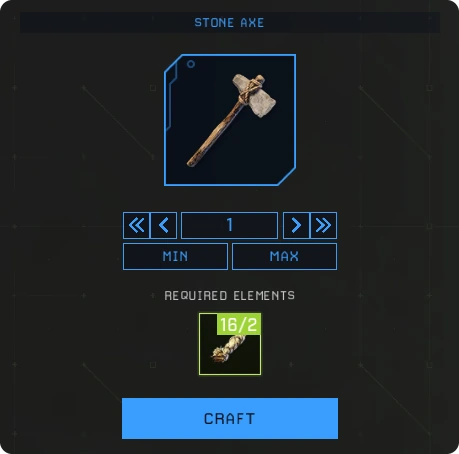
Every change is made through game.Data. It is checked first, it belongs to
your mod, and it is put back when your mod unloads.
Find a recipe
| Function | What it gives |
|---|---|
game.Recipes:Get(name) | One recipe by its name. |
game.Recipes:Has(name) | true when the game has a recipe of this name. |
game.Recipes:All() | Every recipe. |
game.Recipes:At(bench) | The recipes a bench lists: At("Fabricator"), At("Hand"). |
game.Recipes:Making(item) | The recipes that give an item. |
game.Recipes:Using(name) | The recipes that take an item, a tag or a resource. |
game.Recipes:Find(fn) | The recipes your function returns true for. |
- A recipe is named by its row in the game's table
D_ProcessorRecipes. It often has the name of the item it makes, but not always, and some items have several recipes.Makingfinds them all. - A bench is named by the item that is the bench, such as
"Crafting_Bench", or"Hand"for what a player makes without one. - Letter case does not matter. A name the game does not have raises an error that suggests the nearest ones.
Making, Using and Find look through every recipe, which took up to 10 ms each time it was measured.
Call them when your mod loads, inside a task, not every frame. Inside a task they pause after
a millisecond of a frame and go on in the next.
Read a recipe
task.spawn(function()
    for _, recipe in ipairs(game.Recipes:Making("Rope")) do
        print(recipe.Name, "at", table.concat(recipe.Benches, ", "))
        for _, input in ipairs(recipe.Inputs) do
            print("  takes", input.Count, input.Item)
        end
    end
end)| Field | What it is |
|---|---|
Name | The recipe's name. |
Inputs | The items it takes. Each entry has Item and Count. |
Tags | What it takes by tag, such as any raw meat. Each entry has Tag and Count. |
Resources | The resources it takes, such as water. Each entry has Resource and Units. |
Outputs | What comes out. Each entry has Item and Count. |
Benches | The recipe sets it is in. A bench lists the recipes of its set. "Character" is what is made by hand. |
Work | The work making it once takes, in millijoules. |
Requirement | The node of the tech tree that has to be researched first, or nil. |
Hidden | true when the recipe is taken off every list. |
Reading a field reads the game's table, so it is what the table holds now. The lists are yours: changing one changes nothing in the game.
recipe:GetSeconds(bench) gives the time at a bench, in seconds. The time is the work divided by how fast
the bench works. By hand, 2500 millijoules is two and a half seconds. It is the time before talents and
upgrades.
Change a recipe
Every function that changes a recipe gives the recipe back, so changes can follow one another:
local axe = game.Recipes:Get("Stone_Axe")

axe:SetInputs({ Stone = 2, Stick = 1 })
   :SetSeconds(1, "Hand")
:SetRequirement(nil)| Function | What it does |
|---|---|
recipe:SetInputs({ Wood = 2, Fiber = 4 }) | Sets the items it takes. |
recipe:SetInput(name, count) | Sets how many of one thing it takes, and adds it when the recipe does not take it yet. |
recipe:RemoveInput(name) | Takes one item or tag out. |
recipe:ScaleInputs(0.5) | Multiplies every count it takes. A count is rounded up and never goes under 1. |
recipe:ScaleInput(name, factor) | Multiplies the count of one thing. |
recipe:SetOutputs({ Stone_Axe = 2 }) | Sets what comes out. |
recipe:SetOutput(name, count) | Sets how many of one item come out. |
recipe:ScaleOutputs(factor) | Multiplies the count of everything that comes out. |
recipe:SetWork(millijoules) | Sets the work it takes. |
recipe:SetSeconds(seconds, bench) | Sets how long it takes at a bench. |
recipe:ScaleTime(0.5) | Multiplies the work. 0.5 makes it twice as fast at every bench. |
recipe:SetBenches({ "Hand", "Crafting_Bench" }) | Sets where it is made. |
recipe:AddBench(bench), recipe:RemoveBench(bench) | Adds a place, or takes one away. |
recipe:MoveTo(bench) | Makes one bench the only place it is made. |
recipe:SetRequirement(node) | Sets the node of the tech tree it needs. nil means no research is needed. |
recipe:Hide(), recipe:Show() | Takes it off the lists players choose from, and puts it back. |
recipe:Reset() | Takes back everything your mod changed in it. |
The game's crafting tab follows by itself when it is the screen that shows.
Many recipes at once
All, At, Making, Using and Find give a list of recipes. The list has every changing function too,
and does it to each recipe.
task.spawn(function()
    -- everything the Fabricator makes, twice as fast
    game.Recipes:At("Fabricator"):ScaleTime(0.5)

    -- every recipe that takes fiber takes half as much of it
    game.Recipes:Using("Fiber"):ScaleInput("Fiber", 0.5)
end)#listis how many,list[1]the first.list:Each(fn)calls your function with each recipe, andlist:GetNames()gives their names.- When a change is refused for some recipes, the others are still changed. Then an error says how many were not, and why the first was not.
- Inside a task, work on many recipes pauses after a millisecond of a frame. Anywhere else it is all done at once, which for hundreds of recipes is a frame the player can notice.
What this version cannot do
- Adding a new recipe is not possible yet.
game.Recipes:Addis there and raises an error that says it is switched off. - An output cannot be added or taken away. Each output can become another item and another count.
- A resource cannot be added or taken away. How much of a resource a recipe takes can be changed.
- Items, tags and benches can be added and taken away only while the list has 4 entries or fewer, before
and after. Rope, for one, is made at 7 benches, so
AddBenchis refused for it. Changing counts always works. - A bench screen that is open is not built again. The crafting tab is.
A change that is refused raises an error that says so, and changes nothing.
Things to know
- Hiding does not stop a recipe from being made. It takes the recipe off the lists. One that is being made is finished, and the host still makes a hidden recipe when it is asked for by name. The one thing the host was seen to check is research.
- A change can come while something is being made. A new time counts from the next moment. What is taken and what comes out is read when the making ends. If the player cannot pay the new cost then, the making is dropped without a message and nothing is lost. So change recipes when your mod loads.
- Unloading your mod puts every recipe back, also under something that is being made. When that was tried, the making was dropped, and nothing was taken or made.
- When two mods change one recipe,
SetInput,RemoveInput, theScalefunctions,AddBench,RemoveBenchand the output functions build on what the earlier mod did.SetInputs,SetBenches,MoveTo,SetWork,SetSeconds,SetRequirement,HideandShowreplace it.game.Data:Conflicts()lists where that hides another mod's value.
All of this was tried on the host of a prospect, on the crafting tab. It has not been tried on a real bench, as a guest, or after a fresh start of the game.
Every function is listed in the Recipes reference. The bench or crafting screen
that is open is game.Crafting.